Meguro Parasitological Museum
目黒寄生虫館 · Meguro Parasitological Museum
- Ward
- Meguro
- Price
- Free (donations welcome)
- Hours
- 10:00-17:00
- Closed
- Mon & Tue (open if a public holiday; closes the next weekday) and New Year
- Getting there
- 12 min walk from Meguro Station (JR, Toei, Tokyo Metro, Tokyu)
- Founded
- 1953
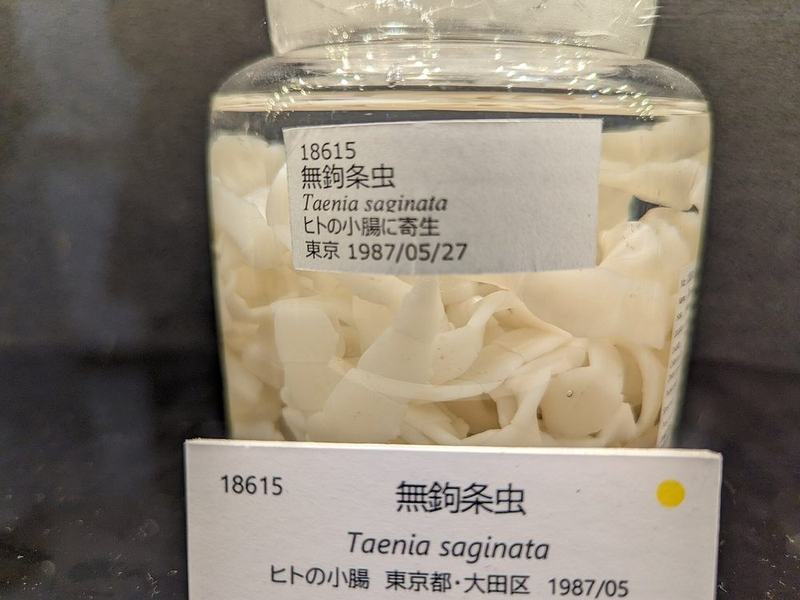
- Beside the 8.8-metre tapeworm hangs a cord of the same length
- Charging admission would go against the founder's principle
- The shop sells real parasites set in resin
We do not republish copyrighted photographs. Use the links below to see the actual venue.
Obvious to locals, invisible to visitors
There is a simple reason guidebooks leave this out: to the people who live here it is too obvious to be worth explaining.
The centrepiece is an 8.8-metre broad tapeworm taken from a human body. A white cord of identical length hangs beside it, so you can pull it out and feel the scale. The man who hosted it reportedly noticed nothing for three months.
Free since it opened in 1953, on the founder Satoru Kamegai's principle that education should not be charged for. A donation box stands at the entrance instead, and the second-floor shop is a vital source of running costs. Finances remain tight.
The second-floor shop sells straps and keyrings with genuine parasites set in acrylic — each holds a different specimen, so you choose. There are also tapeworm T-shirts and a parasite karuta card game.
It closes two days a week, Monday and Tuesday, which catches out visitors planning around a weekend. If either falls on a public holiday it opens and closes on the nearest weekday instead. Hours are 10:00 to 17:00.
Twelve minutes from Meguro station — further than expected. The entrance is very plain and easy to walk past. Inside, the atmosphere is as quiet as a library. Photography is permitted for personal use.
What it is
The only museum in the world devoted solely to parasitology. Founded in 1953 by Dr Satoru Kamegai with his own money. The first floor covers the diversity of parasites, the second those affecting humans, with some 300 specimens on display; the collection runs to roughly 60,000 specimens and 16,000 volumes. Admission is free, sustained by donations and the museum shop.
What to order
Why locals keep coming
It covers one extremely narrow subject, yet has quietly built a following among foreign visitors — because it is free, and because nothing like it exists elsewhere. The director says the aim is to present the specimens beautifully enough to reset how people think about parasites.